All articles

Articles

šŸ‘‹

šŸ‘‹

Three years ago this month I started Dev to Agency... whoa, that's a long time. Originally this was a place for me to decompress... to work through my thoughts and feelings after selling my agency (while taking 12 months off to travel Australia). But I slowly realised I enjoyed sharing the knowledge I had learned (the hard way!), and I built a nice community around it. It then turned into a place for me to find consulting gigs - and through this blog (and newsletter) I helped a lot of d

By Chris
Your clients need something - AI

Your clients need something

The world has changed. AI is no longer a futuristic concept confined to science fiction movies, it's here, it's powerful, it's accessible, and improving by leaps-and-bounds every month (or day?) In 2024, millions of businesses - small, medium, and large - will be turning to their software development providers for one thing: AI. Your Clients Need Something This Year - and it's AI ✨ Businesses are looking to understand how AI can provide them with value, and how to start planning an AI strate

By Chris
Client Bytes - Dev Agency and Freelancer Sales

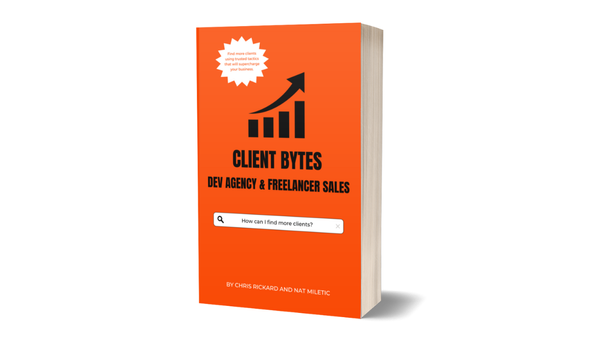
šŸ“™ Book: Client Bytes - Get More Clients

If you want more clients for your dev agency or freelancing business, then I wrote a book for you - it's called Client Bytes - Dev Agency and Freelancer Sales. My good friend Nat [https://twitter.com/natmiletic] (who runs a very successful dev agency in Calgary) co-authored the book to tackle one of the hardest questions... 1. How do I get more clients? 2. Get more work from existing clients? 3. Find the sales and marketing tactics that work best for me? Over 12 months of writing, over

By Chris

Interview with Clarence Ho from Atlasopen

Clarence Ho is the director and founder of Atlasopen, a software development company based in Melbourne, Australia - and he's been an entrepreneur for a long time. I've been friends with Clarence for quite a few years, as we used to work out of the same co-working space. He's a great businessman, and I've been looking forward to hearing his story. Can you introduce yourself & Atlasopen to the Dev to Agency readers? Sure, I'm Clarence and I’m the Founder at Atlasopenm and we’re a software dev

By Chris
Leverage your superpower

Leverage your superpower

There are a million things you need to focus on in an agency, and recently I wrote an article about wearing many hats [https://www.devtoagency.com/wearing-many-hats/] around how learning to do lots of things is a superpower in your agency. This is because it’s what worked for me, and helped me grow a 7-figure business in a couple of years. By learning many new skills fast while staying small and lean. But running your own business needs to be about doing what you want, and I speak to many agen

By Chris
Wearing many hats

Wearing many hats

As an agency owner, one of the biggest challenges is having to juggle multiple tasks and responsibilities - wearing many hats. Unlike larger companies with specialized departments, as a small business owner, you are responsible for everything from development, sales and marketing, accounting, and customer service - you have to wear many hats. Some people hate this. Some people love this. I see it as a necessary part of getting your business off the ground, and if you do it well, you may not

By Chris
Avoiding Parkinson's Law

Avoiding Parkinson's Law

Parkinson's Law tells us that ā€œwork expands to fill the time allotted for its completionā€ - meaning the more time you have the more time things take. And the origin story is about a woman who had to send a postcard. For many people, that may be a 3-minute task. We are busy, so we don’t want to draw it out. But this woman spends an hour looking for the exact right postcard, another half hour looking for her glasses, 1.5 hours actually writing the card, 20 minutes deciding whether or not to tak

By Chris
My experience with burnout

My experience with burnout

Writing an article on the internet about burnout feels a bit like writing about ā€œhow to wake up earlyā€, or ā€œeat better and feel great!ā€ - it feels clickbaity and it’s all been said. Am I really that hard-pressed for content? But the truth is, burnout’s a bitch… It hits us differently, at different times, and for different reasons. And the other truth is, agency life (or running any business) can lend itself towards burning out. It can feel like an endless marathon, and even if you ā€œmake itā€,

By Chris
Handling toxic clients

Handling toxic clients

Unfortunately, not all clients are easy to work with. Some may be overly demanding, always negative always blaming you - or even disrespectful or abusive. Often times these are also the clients that are always asking for discounts or penny pinchers - and the ones you have to chase up their invoice payment 5 times before seeing any money. Working with toxic clients can take a toll on your mental health and overall well-being. It’s important to remember that your time and energy are valuable, yo

By Chris
Setting boundaries

Setting boundaries

Without boundaries, you don’t have a clear cutoff point of what you’re willing to do, and what you’re not willing to do. Whilst this may be ok at the beginning of your business, in the long term knowing exactly where your boundaries are, and communicating these to your clients and staff - will allow you to be more proactive and less reactive. Let’s run through an example without any boundaries set, then the same example of clear boundaries set. Without boundaries šŸ¤·ā€ā™€ļø * It’s 7:15 am and you

By Chris
Bug free software

Bug free software

When it comes to software development, one of the most important goals is to create a product that is bug-free… or at least as bug-free as possible. We all know software bugs can cause a range of issues, from minor annoyances to major disruptions and even security vulnerabilities. Bugs mean more development work and more time re-testing, and if the system is very buggy - it can impact the relationships with your clients. But not every bug is the same. To create software that is as bug-free as

By Chris

Interview with Cody Benedetto from Modern Launch

1. Can you introduce yourself & Modern Launch to the Dev to Agency readers? Hello, fellow Dev to Agency readers! My name is Cody Benedetto [https://www.linkedin.com/in/cody-benedetto/]. My co-founder, Ryan Serkes [https://www.linkedin.com/in/ryanserkes/], and I formed Modern Launch [https://modernlaunch.co/] to provide custom software development for startups and high-growth companies. 2. How did Modern Launch start? Ryan and I share a long history of working with technology and custom so

By Chris
When to raise your prices in your agency

When to raise your prices?

There are many ways your agency can charge. Whether it’s fixed price [https://www.devtoagency.com/pricing-fixed-price/] or time and materials [https://www.devtoagency.com/pricing-time-and-materials/], as your business grows in size or in expertise you will want to raise your prices. But when should you raise them? Raise your prices when you have more work than you need šŸ’Ŗ When your pipeline is consistently full, and you have multiple projects booked into the future, this is generally a sign yo

By Chris
How much should you charge?

How much should you charge?

We all know money makes the world go around, but knowing how much to charge is one of the harder things to figure out when you start an agency or freelance business. There are many methods (including just guessing), but after years of running my agency I’ve come up with a formula that works well. 1. How much does it cost to run your business? šŸ“ˆ Tech businesses can have very low overheads in comparison to others, but it’s still important to know your running costs and to recalculate these ever

By Chris
Balancing technical debt

How to balance technical debt

I’ve been a programmer for most of my life, between working for enterprise companies, and startups, and then running my own software development company, so I have seen the impacts of technical debt from all angles. Avoiding tech debt isn’t as simple as saying ā€œdon’t do itā€. I would say every single software project has a technical debt of some kind (and not all are accidental). I think the best you can do is understand and be aware of it. What is technical debt? šŸ’ø Technical debt is the futu

By Chris
5 common estimation mistakes

5 common estimation mistakes

Great client relationships are built upon meeting (and hopefully exceeding) expectations, but that can be hard to achieve when your project estimation doesn’t go according to plan. Estimation is hard, and I’m not the first to say that. It can take many years and a lot of experience for someone to become a great estimator, but you don’t always have that luxury when starting your own agency or freelance business. You need to provide estimates now, and need to do them as best you can. I’ve been

By Chris
Interview with Neil S Paul from Protorix

Interview with Neil S Paul from Protorix

Neil S Paul [https://twitter.com/neilspaul] is a developer and the co-founder of Protorix [https://protorix.com/], a 15-person app development company based in Chennai, India. They have been running for 3 years, and are going from strength to strength. Like many agency founders, Neil learnt his client services skills by freelancing first, and then along with two close friends, doubled down on those skills to build a successful agency. I chatted with Neil to learn more about his story, the sto

By Chris
Keeping your clients long-term

Keeping your clients long-term

More leads. More sales. More clients. This is the mantra of many agencies, doing everything possible to win new clients. But new clients cost a lot more than existing clients, and depending on which study you believe, a new client project can cost between 5 to 25 as much as a project from an existing client. * You have a whole new relationship to build from scratch * You have an entirely new project to understand and scope * You have a whole new bunch of risks to mitigate Client retention

By Chris
Meeting your client's expectations

How to meet your client's expectations

We all have our own expectations. When you purchase a pizza you expect it to taste good, to solve your hunger problem, and to arrive quickly. But what if you had never bought a pizza before? Maybe you had never even eaten pizza, and only read about them in books. You might expect a pizza comes whole and you need to slice it yourself. Or you might expect that a pizza is always just tomato and cheese - and be surprised to find out you can actually get meat, mushrooms, or even pineapple on your

By Chris
Your agencies first hire

Your agency's first hire

Your first hire will feel like a huge and important decision. You want to get the role exactly right, hire at the perfect time and have ā€œthingsā€ in place before you pull the trigger. The thing is - there will never be a perfect time and you will never be completely ready. At some stage, you need to just jump in and only you know when that’s right for you. When not to hire Put simply, when you have very little work, and when you don’t have the experience delivering quality projects on time. H

By Chris

7 tips for finding your first client

If you’re just starting with your agency, finding your first client can feel like an impossible task. You know what you want to do. You know you can do it. You just need the chance to prove it, right? I’ve been there, and so have millions of others. So here's some advice that has helped many agencies get started. 1. You probably already know your first client šŸ¤ There’s a big chance that someone you know, or an associate of someone you know will be your agency's first client. People make the

By Chris

Your agency's website

You probably know this, but you need a website for your agency. It doesn’t need to be flashy or have lots of content - but you need one. Your website is at the top of your sales funnel, it allows potential clients to: 1. Learn more about what you offer (so they can decide whether it appeals to them) 2. Understand that you can actually do it (via testimonials, case studies, and social proof) 3. Find out what to do next (contact, book a meeting, download a product etc) There are com

By Chris

5 lessons I learned selling my agency

My agency was awesome. I enjoyed going to work every day, working with my wife every day, and was really proud of our highly skilled team. We had awesome clients and we were growing year on year. But even though I got so much out of it, I had run my agency for most of my 30s - and I wanted different experiences out of my 40s. Selling wasn’t my master plan by any means, but it was a nice way to end a great experience - plus give both my staff and clients a good "new home". I thought it might

By Chris

Managing scope creep

Scope creep. Two words that send a shiver down the spine of anyone who works in client services. When managed correctly, scope creep stays in its box, the project gets delivered as planned, and everyone's happy. But unfortunately scope creek does happen, and most people don’t manage it very well. In fact, it's a huge problem (according to the PMI Pulse report [https://www.pmi.org/-/media/pmi/documents/public/pdf/learning/thought-leadership/pulse/pulse-of-the-profession-2017.pdf] ) * 50% of

By Chris

Why agencies can thrive during a recession

Recessions come and go, but when they hit, businesses tighten their belts. They reassess what’s integral, and move from ā€œbusiness as usualā€ mode, to ā€œsurvivalā€ mode. But unlike some other industries, agencies and freelancers have a unique opportunity in a recession. Employees are an ongoing expense, processes need to be automated, and integral software still needs support and maintenance - and agencies can help with all of that. Now I’m not saying agencies are recession-proof, but I am saying

By Chris

Interview with Steve Thomas of Coding Labs

Steve Thomas is a software developer and the founder of Coding Labs [https://codinglabs.com.au] - a development agency based in Queensland Australia. I spoke with Steve [https://twitter.com/steve_coding] recently about his business (which has been running for 17 years!) and I discovered Coding Labs and my previous agency share some key similarities: 1. Initially focused on startup businesses 2. Then moved into building custom software for established businesses 3. Embraces Laravel [https://

By Chris

Pricing - equity and profit share

Welcome to the fifth and final article in my pricing series. Previously I’ve discussed Fixed Price, [https://www.devtoagency.com/pricing-fixed-price/] Time and Materials [https://www.devtoagency.com/pricing-time-and-materials/], a Hybrid combination [https://www.devtoagency.com/pricing-hybrid/] of both, and Value based pricing [https://www.devtoagency.com/pricing-value-based]. For this last article, I talk about two mechanisms that, whilst not a pricing method by themselves, usually impact ho

By Chris

Pricing - value based

Welcome to the fourth article in my pricing series, after Fixed Price, [https://www.devtoagency.com/pricing-fixed-price/] Time and Materials [https://www.devtoagency.com/pricing-time-and-materials/], and a Hybrid combination [https://www.devtoagency.com/pricing-hybrid/] of the both. So the most common formula for pricing a project is 1. You estimate how long it will take for you to complete it 2. Based on the time estimate, you decide how much money you want to complete it Whether it’s

By Chris

Pricing - fixed price + T&M hybrid

Welcome to the third article in my pricing series, after Fixed Price [https://www.devtoagency.com/pricing-fixed-price/] and Time and Materials [https://www.devtoagency.com/pricing-time-and-materials/]. So I found fixed price to be too ridged, and often the negatives outweighed the positives. Whereas time and materials didn’t fly with larger government and corporate projects, where one single price is nearly always required. In the third iteration of pricing methods, I combine the two - a hybri

By Chris

Pricing - time and materials

This is part 2 in the pricing series, part one was about charging a fixed price [https://www.devtoagency.com/pricing-fixed-price/] for client projects. Let's say you charge $125 per hour. Great, that sounds like a fine amount of money, right? And you win a new project you estimate will take 2 months to deliver, at a fixed price. Everything is going well, until you find an unforeseen issue in the 3rd party API you are integrating with. It can’t handle the scale you need - so you have to rebui

By Chris

Pricing - fixed price

In a client services business, how you charge can sometimes be more important than what you charge. It’s not uncommon to experiment with various pricing methods, especially when you are first starting out (I know I did). But it’s important to know that each method has it’s own pros and cons, and to find the method that works best for you will take some firsthand experience. My next few articles will be a rundown on various pricing methods, the benefits and negatives, along with insights based

By Chris

Recurring revenue

The typical work of software agencies, consultants, and freelancers is project-based. You win the project, provide the service, and receive the agreed payment. But project work can be feast or famine, and a large cause of stress within agencies. Your pipeline can be full, but then some projects get delayed or fall through. You can have zero work scheduled, but then within a week you have triple the amount you can handle. This makes forecasting difficult, and results in very lumpy payment sched

By Chris

Interview with Carl Erickson of Atomic Object

At the beginning of starting my software development consultancy I was on the lookout for like-minded companies that shared my values and goals - and one of the first I discovered was Atomic Object [https://atomicobject.com/]. I loved how they positioned themselves, and how they didn't beat around the bush about what they do: build complex software that can create a lot of value, technical excellence, generally 3-18+ month long projects (costing between $50k to 5 million), and even told potent

By Chris
Ownership of Code and Intellectual Property

Ownership of code and intellectual property

A reader asked me an interesting question about this topic, so I thought I should write about source code and IP ownership. However first and foremost, I ain’t a lawyer, and these laws can vary from country to country - so please ensure you confirm this yourself and your specific situation. When you first start an agency or freelancing, ā€œwho owns whatā€ is not often the first thing on your mind. The main issues you worry about are getting projects, getting shit done, and getting paid. But you w

By Chris

Living user story documentation

I’m not sure if living user story documentation is something anyone else does, but I want to talk about why it evolved in my agency, the benefits we saw, and how we implemented it. āœ…Since writing this article I've released Userdoc - and AI-infused requirements management tool to help writing requirements documentation, including User stories, non-functional requirements, user personas, and user journeys. Some caveats: 1. This is pretty specific to client services work, and maybe not so much

By Chris

Compete on quality

Competing based on charging less than your competitors can help you get your business off the ground, but in the long term, undercutting using pricing is a race to the bottom, and there is always someone in the world who can run faster than you. Instead of using price, position your business around quality. For a small business building custom software, focusing on "high quality" over "dirt cheap" is generally a better offering, allowing 1. An emphasis on craftsmanship over just "cutting code

By Chris

Project workshops

A turning point for my agency was when we introduced a project workshop for all new projects. But before I get into that, let me tell you about the good old days... In the early years I would do anything to impress a potential new client, I was very confident that technically we could hit their project out of the park - we just had to first navigate through this awkward sales dance first. Back then I think my dance was pretty stock standard for a developer turned agency owner, I'd woo the clie

By Chris

Referrals from friends and family

Sales. I'll be honest, it's a topic I have been avoiding because its just so BIG. Instead I am going to start with a small chunk of sales - with something that greatly impacted my agency. > "People influence people. Nothing influences people more than a recommendation from a trusted friend. A trusted referral influences people more than the best broadcast message. A trusted referral is the Holy Grail of advertising" ― Mark Zuckerberg A referral is somebody referring your business to somebody el

By Chris

My path from developer to agency owner

I'm sure out there somewhere there have been software developers who started their own successful agencies with little to no industry experience, but for me it was definitely a matter of 'stacking the bricks'. Meaning I needed to accrue certain experiences over a number of years to ultimately be confident making the leap of faith into my own business. And I'm glad I did. I'm not solely talking about programming or technical experience here, in fact for me it was the soft business skills I reall

By Chris

Interview with Matt Stauffer of Tighten

There are just a handful of software agencies which I took inspiration from for my own business, and Tighten [https://tighten.co/] was certainly one of those. A technically focused agency that also cares about humans, Tighten has worked with some well-known clients and are leaders in their chosen technology space - all this while having a relatively small team. When thinking of other voices I'd like to feature on Dev to Agency, Tighten was the first one that popped into my head. Matt Stauffer [

By Chris

Do you need a co-founder to start an agency?

Do you need a co-founder to run an agency? Do you need a partner in the business, with skin in the game just like you? This is a controversial topic in the startup world, we have Paul Graham saying the number #1 mistake he sees in startups is only having a single founder [http://www.paulgraham.com/startupmistakes.html], and on the other hand there are a bazillion articles telling you why you [https://www.businessinsider.com.au/you-dont-need-a-cofounder-anymore-2010-4?r=US&IR=T] don't [https:

By Chris

Million dollar consulting

Apologies in advance, this article is not a step-by-step guide on how to build a consulting company to a cool 1 million - it is in fact a book recommendation. The book is aptly titled Million Dollar Consulting: The Professional's Guide to Growing a Practice [https://alanweiss.com/shop/books/paperback/million-dollar-consulting/] and is written by Alan Weiss. This is not an affiliate post, I'm writing about this book because I dig it, and I hope some of you dig it too. > "Million Dollar Consulti

By Chris

Small can be great

Instead of pretending to be big, your small software agency should be honest and proud of its size. You have strengths that larger agencies don't have, and in my experience if you play to those strengths, then small can achieve great things. > "A small law firm, accounting firm, or ad agency is succeeding because they’re good, not because they’re big." ― Seth Godin That personal touch šŸ¤ No one knows a business better than the owner. You know your niche, experience, and the unique path you cros

By Chris

Think niche

We build web and mobile applications - that's the generic website tagline 90% of your competitors will have. They all look the same, all talk the same, and are all pitching for the same clients as you are. > "If everybody is doing it one way, there's a good chance you can find your niche by going exactly in the opposite direction" ― Sam Walton, entrepreneur and founder of Walmart A niche is a "specialised segment of the market for a particular kind of product or service", and when applied to so

By Chris

What's your end goal?

Phew, you did it. It involved some hard work, but you managed to start a software agency. Your initial fears about clients, staff, and cashflow, are all a distant memory. Congratulations your business is a success! Now, what does it look like? I want you to take some time and really think about what "it" is for you - it being the end goal you are heading towards. By end goal I don't mean the actual end of your business, but the destination you want to reach. > "To begin with the end in mind m

By Chris

You are the gold standard

The gold standard is the measure by which everything else is measured, and when starting a small software agency - or in fact any small business where the owner is also at the coalface of where shit gets done - you have the opportunity of setting the gold standard of what's expected. The quality that is expected, the communication that is expected, the client respect that is expected. You are walking-the-walk as opposed to just talking-the-talk - and this is a superpower of the small that shoul

By Chris

My small custom software development agency

I want Dev to Agency to be a place where software developers who are interested in starting a software development agency (or have already), can learn from some practical examples around how I started, ran, and ultimately sold my agency after 8 successful years. Perhaps I am secretly writing this for my younger self, as this something I found hard to find good information on when starting out in 2012. To get slightly side-tracked for a second, I kind of hate the word "agency". I prefer to cal

By Chris